A watch is a machine with one job — keep time — and everything that matters about buying one follows from how it does that job and what it costs to keep it doing it. The choice that shapes everything else is the movement: mechanical (hand-wound or automatic, a mainspring and an escapement) or quartz (a battery, an oscillator, a stepping motor). Mechanical watches trade accuracy and service cost for craftsmanship and longevity; quartz trades soul for accuracy you never think about. Everything else — case size, water resistance, strap, brand — is a decision you make after that one.
The movement decision comes first, and it is mostly about service
An automatic mechanical watch needs servicing every several years, and that service is a real expense — a full movement overhaul typically runs a meaningful fraction of what a modest watch cost in the first place. A quartz watch needs a battery every couple of years and a gasket check; a movement replacement, when it finally fails, is usually cheaper than a mechanical service. That gap is the honest core of the mechanical-versus-quartz argument, and almost nobody selling you a mechanical watch leads with it.
Mechanical movements are also less accurate by design. A decent automatic will gain or lose a handful of seconds a day; a quartz movement drifts by seconds a month. Neither matters if you check your phone for the time, which is most people. What mechanical watches buy you is a mechanism you can wind, a sweep second hand instead of a tick, and the possibility of a service life measured in decades rather than years. What they cost you is money at the service counter and the mild anxiety of a watch that stops if you leave it off your wrist for a couple of days — hence the winder, a device that exists solely to solve a problem the watch created.
Hand-wound versus automatic is a smaller fork than it looks. Automatic movements use a rotor that winds the mainspring from wrist motion, which suits daily wear. Hand-wound movements are thinner and, for some wearers, more satisfying, but they demand a daily ritual. If you rotate among several watches, an automatic that sits in a drawer will stop; a hand-wound one will too, unless you wind it. There is no free lunch here — only which annoyance you prefer.
The wrong choice is buying a mechanical watch as a tool. If you need to know the time precisely, work outdoors, or simply don't want to think about servicing, quartz is not a compromise — it's the correct answer, and the money you save is real.
Case size, lug width, and the fit problem nobody warns you about
Case diameter is the number every listing shouts and the least useful one on its own. What actually determines whether a watch wears well is the lug-to-lug length — the distance from the tip of one set of lugs to the other — measured against the flat width of your wrist. A 40mm case with long lugs can overhang a wrist that a 42mm case with short lugs sits on perfectly. Overhang is the failure mode: the lugs poke past the edges of your wrist, the watch looks like it's wearing you, and no strap change fixes it.
Measure your wrist circumference with a tape, then measure the flat top of your wrist across. Compare that flat width to the lug-to-lug figure, which most reputable listings publish and many cheap ones hide. If a seller won't give you lug-to-lug, that's information too. Thickness matters nearly as much — a thick case sits high and catches on cuffs, and a watch that snags on your shirt sleeve every time you reach for something will end up in a drawer regardless of how good it looks on the product page.
Lug width, the gap between the lugs where the strap attaches, is the spec that governs your future. A common lug width gives you an enormous aftermarket of straps; an odd one narrows your options to custom makers. Check it before you fall in love with a dial, because a strap is the cheapest way to change a watch's character and the most annoying thing to be locked out of.
Water resistance ratings are minimums, not promises, and they're tested under lab conditions, not in a hot shower. A watch rated for light splashes is not a swimming watch; a swimming watch is not a dive watch. Heat — a hot shower, a sauna — stresses gaskets more than depth does. If you swim, buy for swimming and have the gaskets checked when the battery is changed. If you don't, don't pay for depth you'll never use.
Dial legibility and the complications worth paying for
Buy the dial you can read at a glance, because that's the only time you'll look at it. Contrast between hands and dial, hand length that actually reaches the hour markers, and markers large enough to register in peripheral vision matter more than any finishing detail visible only under a loupe. A watch with beautiful applied indices in a low-contrast color scheme is a watch you'll squint at in a meeting.
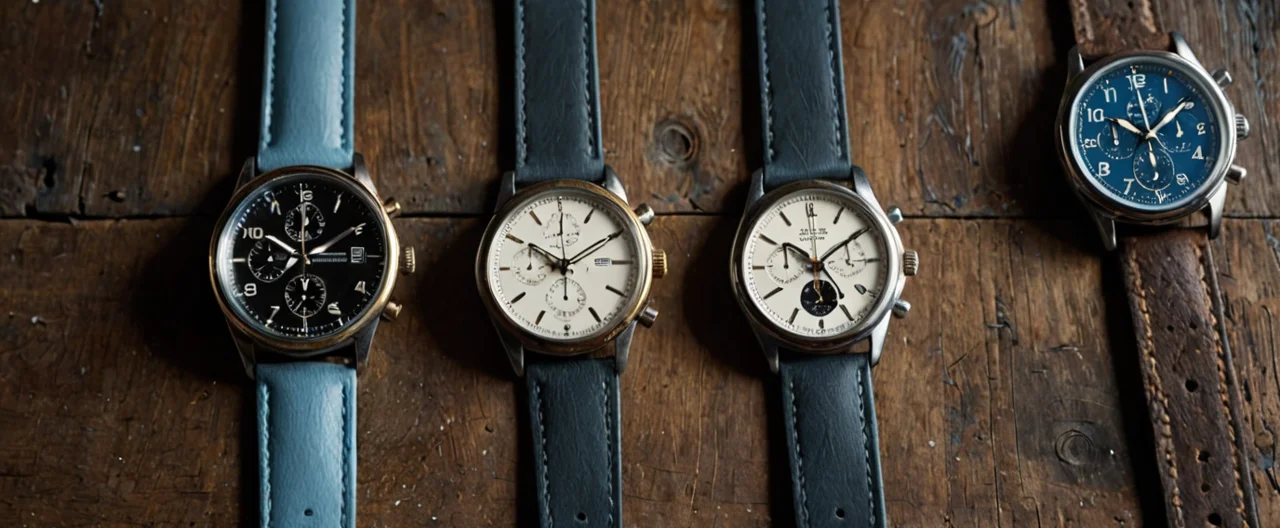
Complications — the extra functions beyond hours, minutes, and seconds — are where watch money goes fastest, and most of them are worth skipping on a first purchase. A date window is genuinely useful and cheap. A day-date adds a little. A chronograph (stopwatch) adds pushers, a more complex movement, more to service, and a thicker case, and most owners use it a handful of times. A moonphase, an annual calendar, a GMT hand — each is a real piece of engineering and each adds to the service bill and the failure surface. Buy a complication because you'll use it, not because the dial looks emptier without it.
There's a counterargument worth hearing: a complication you enjoy looking at is a legitimate reason to own a watch, since a watch is partly an object of pleasure. The trade-off is honest — you pay more up front, you pay more at service, and you accept more things that can break. What you shouldn't do is buy a chronograph expecting to time things and then discover the pushers are stiff and the subdials unreadable. Try before you buy, if only in a store.
Straps, bracelets, and the cost of changing your mind
The strap or bracelet is the part of the watch that touches you all day, and it's the most under-budgeted line in most purchases. A steel bracelet is durable, adjustable, and heavy; a leather strap is comfortable and disposable; a rubber or fabric strap is cheap, light, and handles sweat and water better than leather. None is universally right, and the good news is that swapping is easy — provided your lug width is common and your watch has standard spring bars rather than proprietary quick-release fittings.
Budget for at least one extra strap at purchase. It doubles the watch's range — the same case reads formal on leather and casual on fabric — for a fraction of the watch's price. The cost of changing your mind later is low if the lug width is standard and high if it isn't, which is why the lug width check belongs before the purchase, not after.
Bracelets deserve their own caution. A cheap bracelet with folded links rattles, pulls hair, and develops play at the clasp; a good one with solid links and a machined clasp is a pleasure and lasts. If you're buying a bracelet watch, examine the clasp and the end links where they meet the case — that junction is where cheap construction shows first, as a gap or a sharp edge you'll feel every time you put it on.
Buying used, buying gray, and what a warranty actually covers
Buying used is where the value is, and where the risk is, and both come from the same place: you can't see the movement. A used mechanical watch may be overdue for service, may have been serviced badly, or may have water damage that shows as fogging under the crystal only in humidity. Ask for service history, ask for movement photos, and price in a service if the history is vague. A watch with no service record isn't necessarily bad — it's unpriced risk, and you should treat it that way.
Buying gray-market — from a dealer who isn't an authorized retailer — typically saves money and typically forfeits the manufacturer's warranty. Whether that's a good trade depends on the watch: a robust, easily serviced movement makes the warranty less valuable; a complex one makes it more so. Read the warranty terms before you assume coverage, because many manufacturer warranties exclude water damage, normal wear, and anything done by a non-authorized watchmaker.
The counterfeits and frankens — watches assembled from mismatched genuine and fake parts — live mostly in the used and gray markets, and the tells are in the details: font weight on the dial printing, the finish inside the caseback, the serial number's format. If you can't verify a serial with the manufacturer, you're buying the seller's word. That's fine for a cheap watch and a bad idea for an expensive one.
Setting a budget that accounts for ownership, not just purchase
Price the watch over its life, not at the register. A mechanical watch's true cost is purchase price plus servicing every several years plus any repairs; a quartz watch's is purchase price plus batteries plus the occasional movement replacement. A cheap mechanical watch can cost more to own than a more expensive quartz one, because the service bill doesn't scale down with the purchase price — it scales with the movement's complexity.
Set your ceiling at the purchase price you can afford and the service bill you'd pay without resentment, then work backward. If a service would feel like a betrayal, the watch is too expensive for you regardless of what it cost. If you'd happily pay it, you've found your range. That single test sorts more watches than any spec sheet.
The other budget line is insurance and storage. A watch you wear daily will get scratched, and a watch you store will get damp or magnetized if you're careless — magnets in laptop speakers and bag clasps are the quiet killers of mechanical accuracy. A cheap watch box and a habit of not leaving the watch next to electronics cost almost nothing and prevent the repairs that make ownership expensive.
What you should not do is buy at the top of your budget and then skimp on the strap, the service, or the insurance. The watch is the cheap part of owning a watch; the ownership is the rest. Get the movement decision right, get the fit right, and let the brand and the dial be the last things you choose rather than the first. The watch that stays on your wrist is the one that fits, reads clearly, and doesn't make you wince when it needs attention — and that's a spec sheet you can write for yourself before you look at a single listing.
Magnetism is the accuracy problem you can fix for free
A mechanical watch that suddenly runs minutes fast is usually magnetized, not broken. Hairsprings and escapement parts are steel; set them near a laptop speaker, a bag clasp with a magnetic catch, a tablet cover, or a phone's magnet array and the coils take on a field, shortening the effective spring and speeding the rate. You notice it as a rate change that appears overnight, not as a gradual drift.
The fix is cheap: a demagnetizer costs little and a watchmaker will do it in minutes, often while you wait, and the watch typically returns to its prior rate immediately. The trick is catching it — if you don't track daily rate, you'll blame the movement and price a service you don't need. Note the rate when the watch is running well, and check it if the number moves sharply. Keeping the watch off the nightstand next to the router and away from magnetic clasps costs nothing and prevents most of it.
Quartz watches are largely immune to this, which is one more quiet advantage nobody mentions in the mechanical-versus-quartz argument.
Why the second hand's motion tells you what's inside
A smoothly sweeping second hand means a mechanical movement with a high beat rate; a distinct tick once per second means quartz. That's the fastest way to read a watch across a room, and it matters when you're buying used from a photo or a marketplace listing where the seller may not know what they have.
The middle case is the sweeping quartz, a movement that steps several times per second to mimic a mechanical sweep. It's not deception — it's a legitimate design choice — but it means the second hand alone won't settle the question. Ask for the model number and look up the movement, or ask the seller to confirm whether it takes a battery. A watch that ticks once per second and takes a battery is quartz no matter what the dial says.
Beat rate also predicts service cost: a higher-beat mechanical movement has more to wear and usually a larger overhaul bill, which is worth knowing before you fall for a smooth sweep.